



Introduction
Pisa isn’t just the home of the famous Torre Pendente; it’s an architectural patchwork where solemn classicism meets the decorative flourish of Art Nouveau. Along the streets where the Arno plays with changing reflections, building façades alternate between neoclassical pediments and columns and sinuous ornamentation, delicate ironwork and glazed ceramics inherited from the Liberty movement. Exploring the Art Nouveau and classical neighborhoods in Pisa is like reading the city’s late-19th and early-20th-century urban transformations written in stone, where tradition and modernity conversed on every corner.
Contenu de l'article
This article offers an immersive — and practical — route to spot the visible traces of these aesthetics in Pisa: from the monumental spaces and religious buildings of the Piazza dei Miracoli to the bourgeois façades along the Lungarno and Borgo Stretto, and on to reworked palaces and private villas where Art Nouveau left its mark. You’ll find full place names, exact addresses, typical opening hours, indicative prices in euros, and local tips to get the most out of each stop. Whether you’re a photographer, an art-history student, or a curious traveler, this guide gives concrete landmarks to plan your itinerary.
We’ll also focus on the sensory experience: where to sit to catch gilding in the morning light, which streets to pick at sunset for the best neoclassical perspectives, and which cafés make the perfect pause to soak in the sartorial atmosphere between visits. You’ll get practical advice on skip-the-line tickets, best times to avoid crowds (important around the Torre Pendente di Pisa), and tips for photographing Art Nouveau details—floral motifs, stained glass, wrought-iron entrances—without disturbing residents or breaking the calm of quiet neighborhoods.
Finally, to bring the article to life, image markers have been inserted at the most relevant spots to help you visualize each leg of the route: façades at dawn, views from bridges over the Arno, carved doorway details, and museum interiors where classicism is still on display. These visual cues will help you pack the right camera gear and a notebook for an organized, inspiring exploration of Pisa between Art Nouveau and classicism.

The Classical Core: Piazza del Duomo and Its Monuments
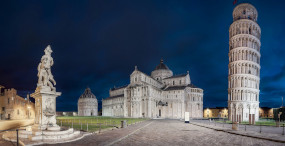
No Pisa itinerary is complete without spending time in the Piazza del Duomo (also called the Piazza dei Miracoli), the city’s classical heart. This is where the most monumental strands of local architecture unfold: the Duomo di Pisa (Cattedrale di Santa Maria Assunta), the Battistero di San Giovanni, the Torre Pendente di Pisa (Leaning Tower) and the Camposanto Monumentale. Exact address: Piazza del Duomo, 56126 Pisa PI, Italy. The square concentrates masterpieces of Pisan Romanesque, where white marble and rhythmic colonnades teach a lesson in reinterpreted medieval classicism.
Detailed description: the Cattedrale di Santa Maria Assunta stretches out with a polychrome façade, rich in stacked arcades and inlaid marble; inside, with its vaults and mosaics, it exudes a hushed majesty. Typical opening hours: generally 9:30–19:00 (times vary with seasons and religious services). Entrance to the cathedral is often free but can be limited or subject to a small admission contribution depending on visitor flows and religious events—budget around €0–5 as a donation.
The Battistero di San Giovanni (Piazza del Duomo, 56126 Pisa PI) stands out for its dome and remarkable acoustics. Typical hours: 9:00–18:00; indicative ticket price: €5–8. The Torre Pendente (Piazza del Duomo, 1, 56126 Pisa PI) has an entrance fee: a standard ticket to climb the tower costs roughly €18–23 depending on season and concessions. Hours: often 9:00–20:00 in summer, reduced in winter; booking is recommended in high season.
The Camposanto Monumentale (Piazza del Duomo, 56126 Pisa PI) completes the classical set with cloisters and restored frescoes. Price: €5–8; hours similar to the Battistero. Practical tip: buy a combined « Pisa Monumenti » ticket that bundles access to the Camposanto, the Baptistery, and the Opera Museum to save money and streamline your visits.
Location and visiting tip: arrive early (8:30–9:30) to enjoy façades bathed in low light and to avoid the crowds. For photographers, the best results are often at sunrise on the south side of the square—the light brings out the relief of the columns. If you plan to climb the Torre Pendente, pick morning time slots outside weekends and book online on the official site to skip the line.
 Click here to book access to the Piazza dei Miracoli monuments

Borgo Stretto and the Lungarno: Neoclassical Elegance and Historic Shops
A short walk from the Piazza dei Miracoli, the Borgo Stretto neighborhood and the banks of the Lungarno reveal Pisa’s civic, commercial face of classicism. Borgo Stretto began as a medieval street that became a bustling shopping artery, where arcades, wrought-iron balconies and neoclassical façades create an elegant promenade. Main address: Borgo Stretto, 56125 Pisa PI. Long arcades house historic cafés, bookshops and artisan workshops.
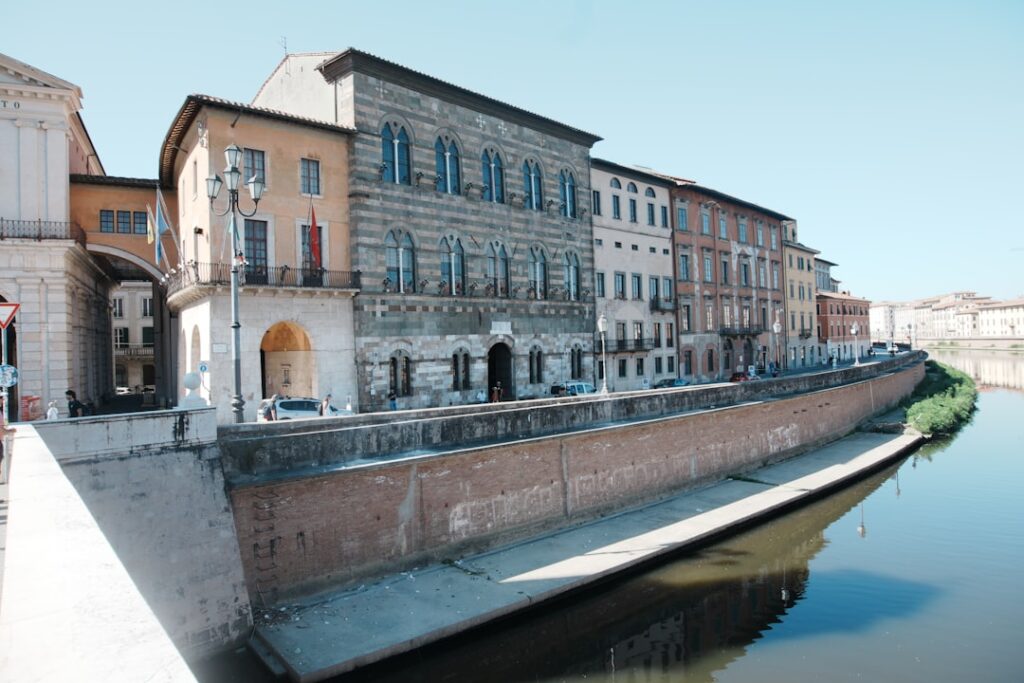
The Lungarno Gambacorti runs along the Arno and offers panoramic views of aristocratic façades and the tiny church of Santa Maria della Spina (Lungarno Gambacorti, 56125 Pisa PI). This diminutive Gothic chapel, finely carved and richly ornamented, is a delicate classical jewel. Hours: often 10:00–18:00; free entry or a small suggested donation (€0–3) during guided visits or temporary exhibitions.
Architecturally, Borgo Stretto features many classical elements: pediments, cornices, doorways topped with masks and stone balustrades. The Palazzo Gambacorti (Lungarno Gambacorti, 9, 56125)—now a city hall or municipal building depending on the configuration—is a fine example of public reuse of a neoclassical palace. Stroll on to the Piazza dei Cavalieri (Piazza dei Cavalieri, 7, 56126 Pisa PI): this square, redesigned in classical and baroque styles, houses the Palazzo della Carovana, headquarters of the Scuola Normale Superiore (guided tours may be available).
Practical tips: Borgo Stretto is ideal for a coffee break. Try an espresso at one of the traditional bars under the arcades; note that terrace service is usually pricier (expect about €1.20–3.50 for a coffee, more if seated outdoors). Shops typically open from 9:00–20:00, with some closed on Sunday. Photographers should aim for the golden hours (late afternoon) to capture reflections on the Arno and the classic silhouettes against the sky.
Art Nouveau in Pisa: Villas, Façades and Italian Liberty Details
The Art Nouveau movement, known in Italy as « Liberty, » left quieter but meaningful traces in Pisa. You’ll spot Liberty mainly in private residences, small hotels and testifying apartment buildings in residential areas near Viale delle Piagge, Via Palestro and certain stretches of the Lungarno. These buildings, dating from around the turn of the 20th century, display hallmark features: sinuous wrought-iron balconies, colored stained glass, mosaics and floral friezes.
Notable addresses: Via Palestro (central sector, 56100 Pisa PI) where several buildings show visible Liberty decoration from the street; and Viale Regina Margherita, where a few private villas still have wrought-iron gates and interior woodwork. Buildings are usually only accessible from the outside since many remain private residences—so respect domestic life and stick to photographing façades. For interior visits, look out for temporary exhibitions or heritage open days that occasionally open private houses to the public.
A cultural spot to check: the Palazzo Blu (Lungarno Gambacorti, 9, 56125 Pisa PI) regularly hosts exhibitions on modern art and interior decoration from the 19th and 20th centuries. Hours: typically 10:00–19:00; indicative prices €6–12. Temporary shows focused on Liberty sometimes display furniture, posters and period objects from municipal collections.
Observation tips: to spot Art Nouveau motifs, look for decorative panels around entrances (cartouches, owner initials), stained glass with botanical motifs, free-flowing curved balcony railings, and stylized heads carved on lintels. Bring a mid-range lens (35–50mm) to capture whole façades from the sidewalk and an 85–135mm lens for carved details. Respect « privato » signs and avoid entering inner courtyards without permission: most façades already offer rich visual content from public spaces.
Click here to book a walking tour of Pisa
Museums, Churches and Small Neoclassical Gems to Visit
Beyond the big scenes, Pisa has museums and churches that sum up the dialogue between classicism and modernity. The Museo dell’Opera del Duomo (Piazza del Duomo, 56126 Pisa PI) preserves sculptures, relics and original works from the cathedral and baptistery. Hours: 9:00–19:00 depending on season; indicative price: €5–8. The museum helps trace the local stylistic evolution from Romanesque to neoclassical and shows pieces often removed from façades for conservation.
The Palazzo della Carovana (Piazza dei Cavalieri, 7, 56126 Pisa PI) is a remarkable example of classical courtyard architecture, remodeled in the Renaissance and the 18th century. Occasional guided tours let you access state rooms and interior decorations; prices and hours vary with cultural events. The Palazzo Blu (Lungarno Gambacorti, 9), mentioned above, is another cultural space where thematic exhibitions connect the classical past with modern artistic practices.
For a more intimate experience, the Orto Botanico di Pisa (Via Luca Ghini, 13, 56126 Pisa PI)—one of the oldest university botanical gardens in the world—displays greenhouses and beds organized according to a scientific and aesthetic logic inherited from the academic tradition. Hours: generally 9:00–17:00; price: about €5–7. Wandering the garden shows how classical aesthetics extend into the strict layout of paths and beds.
Practical tips: to enjoy museums without stress, buy combined tickets when available, arrive 30 minutes before closing for a quieter final walk-through, and check official sites for closures due to exhibitions or restoration work. Audio guides or guided tours in English are often available at the Museo dell’Opera and Palazzo Blu; reserve them in advance in high season.

Suggested Route and Local Practical Tips
Here’s a one-day (or two half-day) route that combines classicism and Art Nouveau, primarily on foot so you can savor architectural details:
- Morning: start at Piazza del Duomo (Piazza del Duomo, 56126 Pisa PI) — visit the cathedral, the baptistery and climb the Torre Pendente (book ahead). Duration: 2–3 hours.
- Late morning: walk to the Museo dell’Opera del Duomo and the Camposanto Monumentale (combined ticket recommended).
- Lunch: Borgo Stretto — pick from trattorie and cafés under the arcades. Average budget: €12–25 per person for a full meal (main + drink).
- Afternoon: stroll along Lungarno Gambacorti to the Piazza dei Cavalieri; visit the Palazzo della Carovana (if open) and the Palazzo Blu for a Liberty/Liberty design exhibition.
- Late afternoon: walk the Lungarno at sunset, then explore Art Nouveau façades toward Via Palestro and Viale Regina Margherita.
Logistics tips: most sites accept card payments; carry some cash for small donations or cafés. Hours change off-season—in winter many attractions close earlier (around 16:00–17:00). Getting around: Pisa is easy to explore on foot, but city buses connect farther neighborhoods. For photos, bring a lightweight tripod if you plan night shots (check each site’s rules on tripod use).
Safety and respect: residential areas are usually peaceful—observe quiet, especially in the evening, and avoid blocking private entrances. Locals appreciate simple courtesy in Italian: a quick “Buongiorno” and a “Grazie” go a long way. If you’re planning interior visits to private Liberty villas, check ahead with the tourist offices Ufficio Informazioni e Accoglienza Turistica (IAT) — Piazza Vittorio Emanuele II, 56126 Pisa PI — to find out when special visits are scheduled.
Click here to buy a ticket for the cathedral, baptistery and Camposanto
Finally, if you plan interior visits to private Liberty buildings, check in advance with the tourist offices Ufficio Informazioni e Accoglienza Turistica (IAT) — Piazza Vittorio Emanuele II, 56126 Pisa PI — to know when exceptional visits are organized.

Where to Eat and Stay to Extend the Atmosphere
To prolong the experience, choose places that echo the day’s aesthetic. Near Piazza del Duomo, traditional trattorie like Trattoria da Bruno (approx. location: Borgo Stretto area) or cafés beneath the arcades serve antipasti, pasta and Tuscan wines at reasonable prices (main course €10–18). For a more refined meal, pick a restaurant along the Lungarno with an Arno view—expect menus in the €20–40 range per person.
For accommodation, favor boutique hotels or converted palaces to stay in the right mood:
- Hotel Bologna Pisa (Via de’ Rossi, 2, 56127 Pisa PI) — central location, classical ambience.
- Palazzo della Rosa B&B (various addresses) — small addresses in historic converted buildings.
- Boutique hotel near Lungarno — riverside hotels for views and morning walks.
Indicative budget: double rooms in 3–4 star hotels €70–160 per night depending on season; charming B&Bs €50–90. Book ahead for university fairs and cultural events (the Scuola Normale often hosts conferences).
Conclusion
Pisa is a city where monumental classicism and the whispers of Liberty answer each other in an ongoing dialogue: the solemnity of the Piazza dei Miracoli’s monuments sits beside the intimate grace of Art Nouveau façades in residential districts. Walking from the cathedral to the Lungarno, pausing at a wrought-iron balcony or getting lost in an exhibition at Palazzo Blu, you’ll perceive how successive architectural movements enriched the city’s urban fabric. Key addresses — Piazza del Duomo (Piazza del Duomo, 56126 Pisa PI), Torre Pendente di Pisa (Piazza del Duomo, 1), Palazzo Blu (Lungarno Gambacorti, 9) and Orto Botanico di Pisa (Via Luca Ghini, 13) — serve as anchors to explore multiple historical and aesthetic layers.
Practically, consider combined tickets to save time and book the Torre Pendente online; favor morning slots for photography and quieter discovery. Respect private spaces when admiring Liberty villas and look out for heritage open days for special interior visits. Above all, leave time to wander: the best discoveries often come from straying off the planned route, taking the air on a bridge at sunset, or stopping for an artisan gelato on a grassy square.
Whether your visit is brief or you take time to dive deeper, Pisa offers a rich architectural palette where classicism asserts its grandeur and Art Nouveau whispers refined details. Bring a notebook, comfortable shoes, and a curious eye: the city will give up its secrets, stone by stone, façade by façade.